
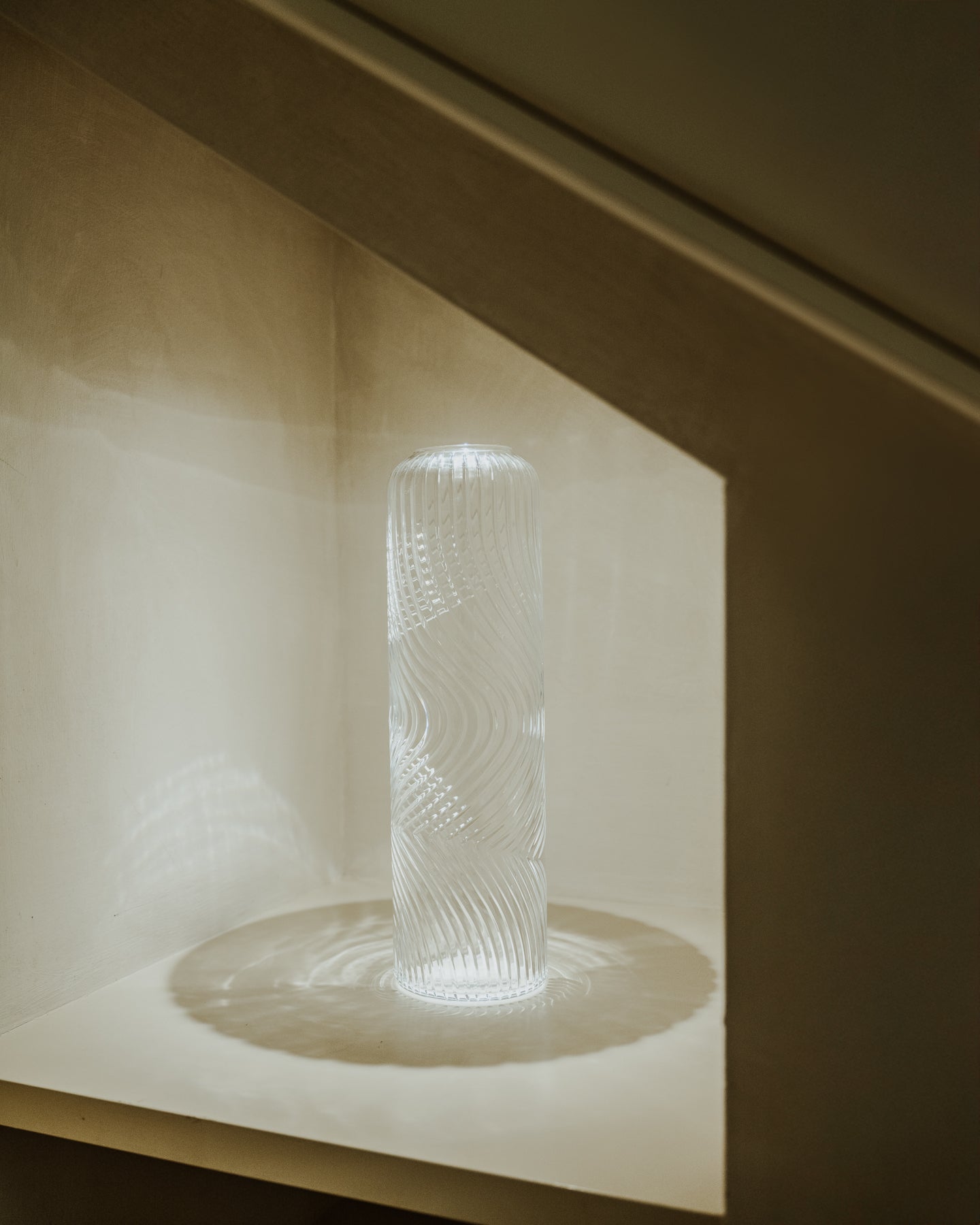


At last, the void shines
Crystal, and the ornament that — against all suspicion — does not fill: it frees.
There is a misunderstanding, when it comes to crystal: the belief that its calling is to be noticed. To reflect, to sparkle, to catch the light with a certain polite insistence. In truth, crystal — at least when it is treated as a material of design and not as mere ornament — seems interested in something else entirely: not in occupying space, but in making it more legible. In letting it breathe. In granting it that rare luxury which the architect Adolf Loos (1870–1933) might have appreciated, while raising an eyebrow: the void.
In Ornament and Crime, the best-known essay collected in Parole nel vuoto (Adelphi), Loos does not simply rail against decoration. That would be too easy, and not cruel enough. He rails against the anxiety of adding, against that bourgeois fear of silence which turns every surface into a missed opportunity to keep quiet. "The evolution of culture is synonymous with the removal of ornament from objects of everyday use," he writes: a sentence so spare it seems already furnished. For Loos, superfluous ornament is a waste of time, of material, of thought. A kind of small talk applied to objects. Or, if we wish to be less severe than he was — though only out of good manners — it is the moment a thing stops being necessary and starts explaining itself too much.
This is where Studio Bojola's work with crystal becomes interesting, precisely when it stops behaving like a catalogue. It does not set out to decorate the world, but to do something far harder: to take noise away from it. Craft is understood not as virtuosity to be shown off, but as a discipline of the eye: present and transparent, precious and discreet, able to become a jewel or an object for the home without ever claiming the centre of the room. Which, let's admit it, is a rather rare form of elegance at a time when even lamps seem eager to open a personal account.
Studio Bojola's place, in this sense, is not a picture-postcard landscape detail — even if certain Italian hills do everything they can to audition for the part. It is a space made to serve rather than to represent: to keep material safe, to let the work happen, to let precision count for more than proclamation. No emphatic gestures, no anxious stage sets.
Loos, who distrusted aesthetic gestures that were too pleased with themselves, might have recognised in this restraint a form of practical intelligence. "Do not be afraid of being called unmodern," he warned elsewhere: changes to tradition are allowed only when they are an improvement. A perfect sentence for any place that does not pretend to be something else, but becomes exactly what it has to become.
In this precise zone — where the project has not yet become a product, and the product has not yet let it go to its head — Studio Bojola lets a less obvious calling of crystal show through. Less an object to count than a principle to observe: every form a dialogue between material and vision, every detail the outcome of a well-conducted conversation in which no one interrupts the material while it is speaking.
Even where there is a story of hands, apprenticeships and sensibilities passed down, the point is not to turn it into a founding myth with violins in the background. That would be, precisely, too ornamental. What matters instead is the way a design attitude passes from one gesture to the next: through proximity, through observation, through mistakes corrected in silence, through that kind of patience which today risks looking revolutionary simply because it needs no notifications.
Because the void, in Loos, is not absence. It is measure. It is the space left free so that whatever remains has a reason to remain. In a place of making, this idea takes on an almost domestic concreteness: the void is not theory, it is a workbench, the distance between one material and another, light coming in without asking permission, useful silence. There, crystal can be worked as if every cut had to justify its own existence: not a decorative whim, not an arabesque to please the eye, but a clean, clear, almost moral decision. It is no accident that Loos goes so far as to say: "Ornament does not heighten the joy of life of the cultivated person." Drastic, certainly. But extremely useful, especially when everyone around seems convinced that the joy of life depends on one more Greek key. Ornament, when it is there, is no longer a crime: it has been questioned, acquitted and put back in its place — ideally without a press conference.
So crystal stops being an object to own and becomes an exercise in attention. An invitation to look more closely, to take away before adding, to prefer an exact line to a brilliant but long speech. In this sense, it is not only about what we wear or what we place in a home. It is about a way of being in the world: with precision, with lightness, with a certain wariness of anything that shouts "design" the moment it steps into the lift. And perhaps also with the calm of knowing that the most contemporary luxury is not excess, but not having to keep proving that it is luxury at all.
If Loos wrote words into the void, here Studio Bojola seems to be trying to engrave light into the void: not to fill it, but to make it visible. Crystal then becomes the most fitting medium for this small, happy contradiction: to be there without taking up too much room, to shine without making noise, to turn ornament into a measured presence. "We have outgrown ornament," Loos wrote, with his particular gift for sounding at once like a prophet and an exasperated neighbour. But outgrowing it, perhaps, does not mean abolishing it: it means making it earn its place. It is a philosophy that runs through the project before the object, the place before the brand, the material before its final seduction. Because true refinement does not lie in adding something beautiful, but in knowing exactly when to stop — and in doing so with enough grace that it need not be underlined.